
AI severity scoring for chronic skin conditions
In developmentThe AI Severity Classifier assesses the severity of chronic skin conditions from photos that patients take with the app. Atopic dermatitis leads: its validation study is under way, and the classifier is being integrated into the hospital information system of Charité. Psoriasis and vitiligo follow in the pipeline.
From a photo to a severity assessment
Severity changes between visits, and the visit only sees one day of it. Photos taken where the patient lives fill the gaps in the record.
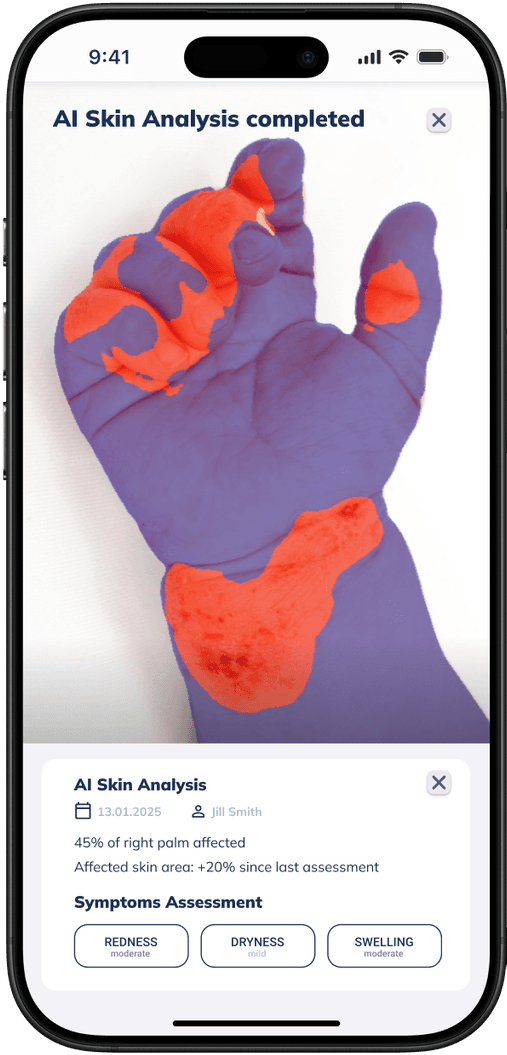
Photo with the app
Patients photograph affected skin with the app, at home or during a visit at the clinic.
Severity assessment
A machine-vision model analyses the photo. For atopic dermatitis it grades redness, swelling, oozing, scratch marks, thickening and dryness, each from 0 to 3. The assessment is oriented on SCORAD.
Review by the physician
The assessment goes into the documentation and supports the physician's decision.
Quality starts with the photo
A severity assessment is only as good as the photo behind it, and photos taken at home differ in light, distance and phone. That is why the classifier never works alone: our own AI models check and standardise every photo before it is assessed.
Image-quality check
Proprietary AI models check whether a photo is fit for assessment.
Photo standardisation
Further proprietary models standardise the photo, so that pictures from different phones and settings can be compared over time.
Severity assessment
Only then does the classifier assess the severity.
Three indications, one approach
Atopic dermatitis, psoriasis and vitiligo together form the core of chronic inflammatory dermatology. We build the classifier for all three: atopic dermatitis (KI-AD) is in the validation study, psoriasis (KI-PSO) in the pre-study and vitiligo (KI-VIT) in the funding stage. AbbVie Deutschland supports our work on AI-supported care for atopic dermatitis.
Questions partners ask
What does the AI Severity Classifier assess?
The severity of chronic skin conditions from a photo. For atopic dermatitis it grades six signs, redness, swelling, oozing, scratch marks, thickening and dryness, each from 0 to 3. The assessment is oriented on SCORAD.
Full answerIs the AI Severity Classifier validated?
The validation study for atopic dermatitis (KI-AD) is under way at Charité. We will report the classifier's performance with its results.
Full answerWho decides on the severity of atopic dermatitis?
The physician. The classifier's assessment supports the documentation and the physician's decision.
Full answerWhich scores do the apps Nia and Sorea use?
Established dermatological scores on severity and quality of life, such as the DLQI, recorded by the patient in the app. Both apps are class I medical devices, CE-marked.
Full answerCan photo-based severity assessment be used in a clinical study?
Yes. Photo documentation is part of the Digital Trial Companion. Write to us with the indication and design of your study.
Clinical trials
Discuss a project
Pharma, clinics, research institutes and health insurers: tell us about your project.